June 2026
Sales Isn’t Complicated. We Just Make It That Way.
Create pipeline. Close deals.
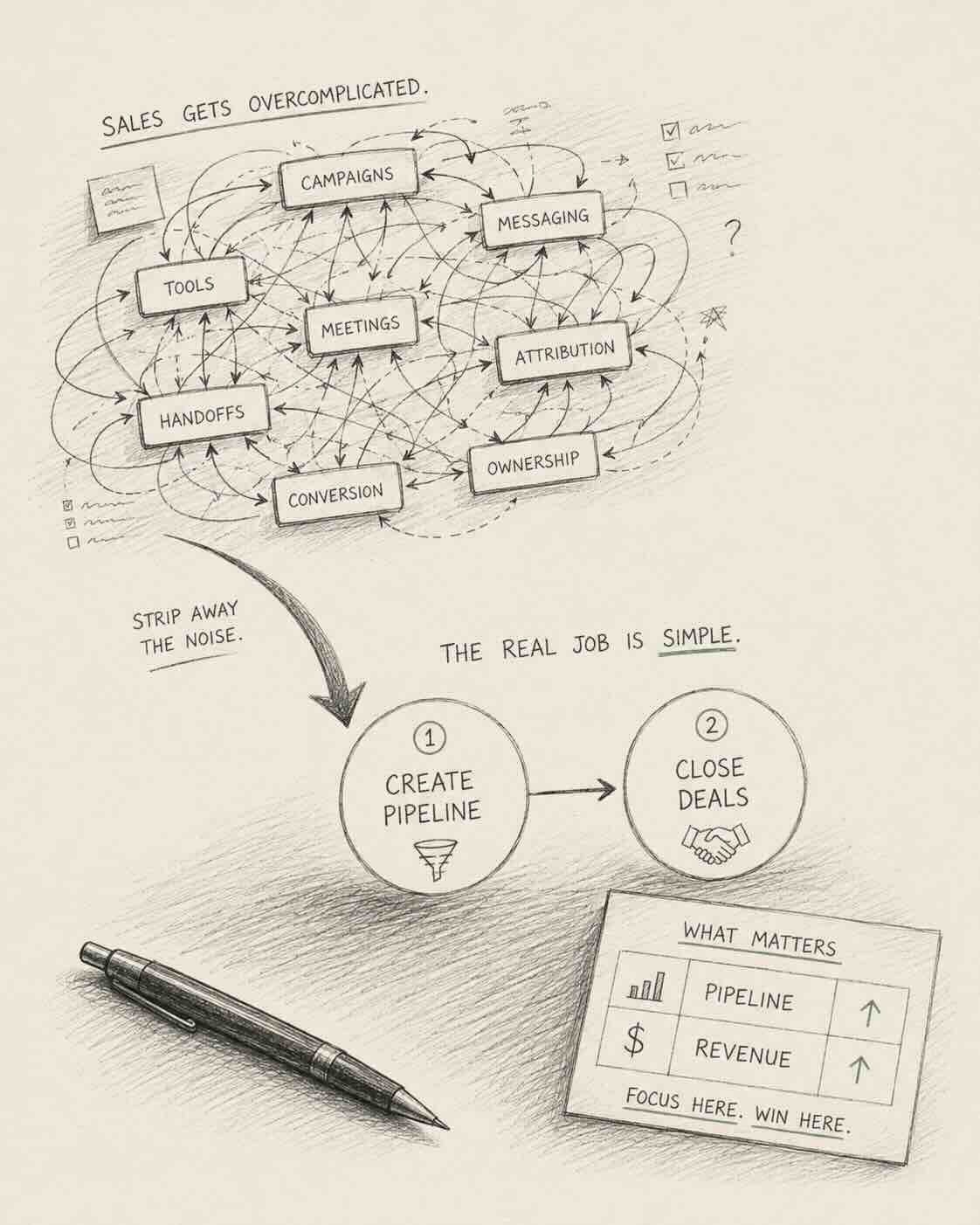
Most sales teams get more complicated over time. New campaigns. New messaging. New tools. More meetings about leads, attribution, handoffs, conversion, and who owns what. Some of that is useful. A lot of it creates noise. And somewhere in the noise, it becomes easy to lose sight of the job.
Sales comes back to two responsibilities.
Create pipeline. Close deals.
That’s it. That’s the job. The scoreboard reflects it pretty clearly too. Pipeline and revenue. Everything else matters only to the extent that it helps one of those two things happen.
Of course, simple doesn’t mean easy. Creating pipeline is hard. Closing deals is hard. Both are made up of dozens of smaller decisions that show up every day. Who you target. What you say. How you follow up. How you run a call. How you earn trust. How you create urgency without manufacturing pressure. How you move something forward when it starts to stall.
There is a lot underneath it.
The scoreboard just doesn’t care.
It doesn’t track how complicated the market is. It doesn’t care how many tools you use, how many campaigns are running, or how many internal conversations happened before a lead landed on someone’s calendar. It tracks what happened. Did pipeline get created? Did revenue close?
That is where teams and reps start to separate.
Some people are at their best when demand is already there. When inbound is flowing, the calendar fills up, activity looks good, and things feel healthy. Then the flow slows down, and the truth shows up. There is no consistent way to create opportunities when the market is quiet.
Others are better once a real deal exists. They are steady. Thoughtful. Good in the room. They can diagnose, guide, and move something forward. And they are still dependent on someone else to create the opportunity in the first place.
Both types can work for a while, especially in a company where marketing is doing a lot of the heavy lifting. But eventually the math catches up. At a certain price point, with a certain kind of customer, pipeline can’t be something people hope arrives. It has to be created.
The people who stand out over time operate differently. They don’t wait for perfect conditions or a full calendar to begin. If something needs to exist in the pipeline, they go create it. If a deal should move forward, they find a way to move it. They still use the tools, the messaging, the campaigns, and the process. They just don’t confuse any of those things for the job.
Sales has a way of revealing the truth over time. Pipelines either grow or they don’t. Revenue either shows up or it doesn’t. The patterns become hard to explain away.
The mistake is usually not effort. It’s diffusion. Too much attention goes to everything around the job, and not enough goes to the job itself.
Bring it back to first principles. Where is your pipeline actually coming from? What happens once a deal starts? Where are you relying on others more than you realize? Where are you creating motion that looks useful but doesn’t move the scoreboard?
There is a lot that goes into doing sales well. More than most people think. But it all ladders back to the same two responsibilities.
Create pipeline. Close deals.
Everything else is just how you do it.