August 21, 2026
Great At The Thing. Bad At The Business.
What one company, an unread book, and one unforgettable speech still teach me about mastery, letting go, and the business of the thing.
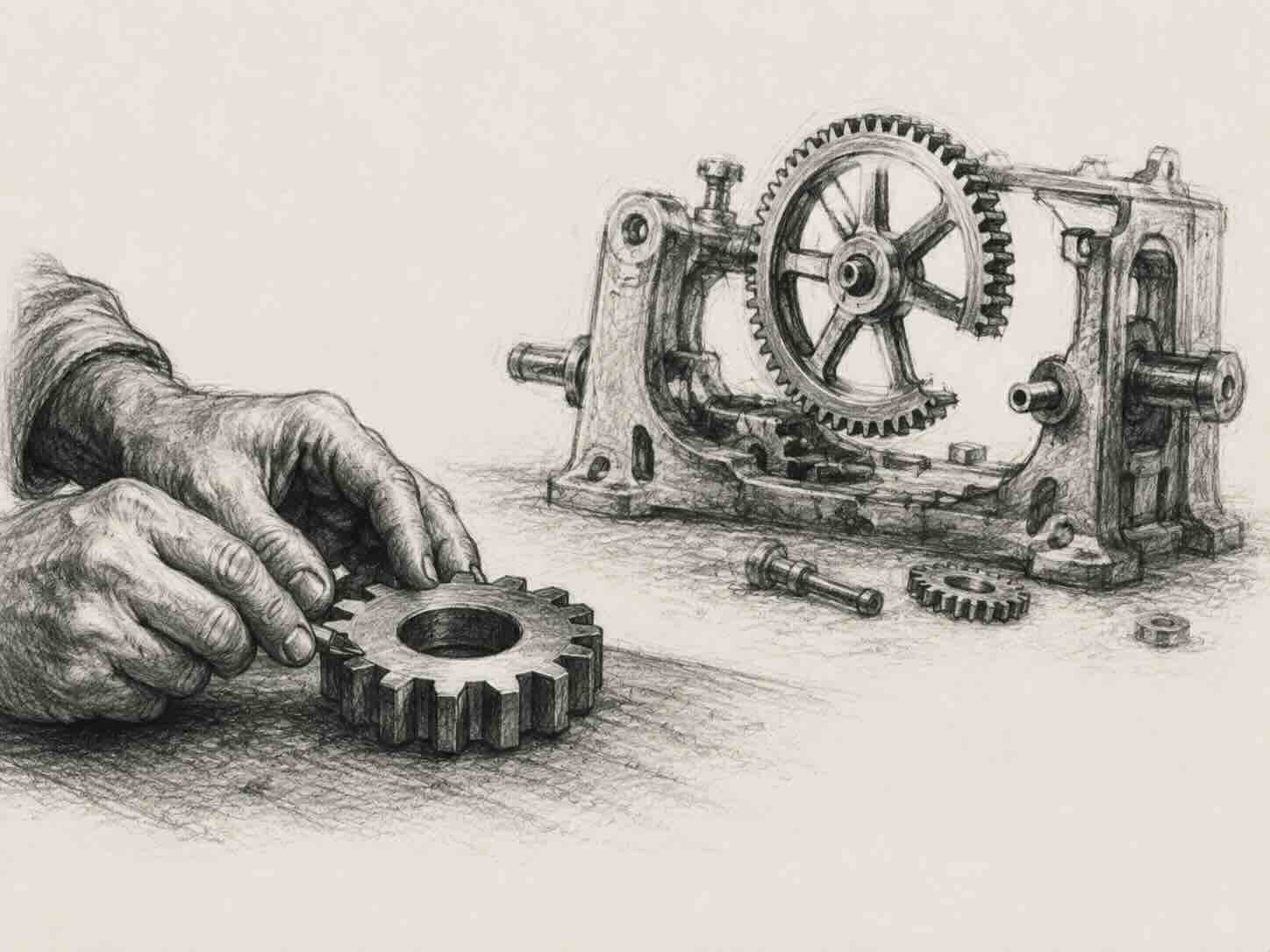
I’ve been mentoring someone for the past five years. About a year ago, with some encouragement, he finally took the entrepreneurial plunge. Today his YouTube channel has passed a million and a half views, he’s helped thousands of people break into tech sales, and he’s closing sponsorship deals and corporate training contracts on his own. By almost every outward measure, he’s winning.
He’s also making the exact same mistake most fast-growing founders make. He just doesn’t know it yet. I know that firsthand, because I was in his exact shoes.
Before I started my first company, I was in California selling NetSuite. I was good at it. I was also watching for something most people in that seat never bothered to.
There was a real supply and demand imbalance. Plenty of companies were buying NetSuite. Almost nobody out there actually knew how to make it work once they had it. My future business partner saw the same gap.
So I quit, moved to Austin, and started a company built entirely around that gap. I knew how to sell. That was the thing I was great at. What I didn’t know was how to be in the business of it, and I didn’t yet realize that selling and running a company built around selling were two different skills entirely.
The dangerous part was that the mistake didn’t look like a mistake. It looked like growth.
I kept selling. Revenue kept coming in. We hired more people. Everything around me reinforced the idea that I should keep doing the thing I was best at.
But my job had changed before I had.
I was still thinking of myself as the best salesperson the company had, when the company increasingly needed me to become something else. It needed someone building the systems and processes that could handle the growth we were creating. Instead, I hired people to help me sell faster. I never built the thing that would have let them sell without me.
Decisions that used to take one conversation between two people who trusted each other started taking longer, and meaning less, the bigger we got, because too many of them still ran through me.
I needed someone to tell me this was happening. Nobody did.
The strange part is the answer was already there, in a book I’d owned for years and never opened.
I got that copy of The E-Myth Revisited from a colleague at my first job out of college. It sat unread on a shelf for seven or eight years, through every year I spent dreaming about what it would feel like to finally start my own company.
The book that would have told me exactly what I was about to get wrong had been sitting a few feet from where I dreamed about it every night, and I’d never opened it.
Around the second year of that business, I finally read it. It named the mistake accurately, almost immediately. What it couldn’t do was hand me the muscle memory for actually running a company differently while I was already three steps behind on the one I had.
Understanding a mistake and rebuilding around it in real time turned out to be two very different skills, and nobody was showing me how to do the second one.
I gave a copy to my business partner too, hoping he’d see what I was starting to see. He never read it. I don’t think either of us fully understood yet that we needed to.
Then, purely by dumb luck, I found out the book’s author, Michael Gerber, was coming to speak in Austin. I jumped at the chance to see him.
He was already in his early seventies. He walked out in an all white suit and a purple tie. No notes in his hand. No slides to point to, no prompter to read from. Just a microphone and a room full of people, and he held that room for the better part of two hours without a single wasted beat.
I’ve seen President Bill Clinton and Governor Rick Perry speak in person, close enough to watch two men who’d spent their entire careers learning how to work a crowd. Gerber held his own next to both of them, and he did it without a single prop to hide behind.
I can’t remember his exact words anymore, but the message landed hard. Most of us hadn’t fallen in love with running a business. We’d fallen in love with doing the work, then assumed a business built around that work would somehow take care of itself.
The room went quiet in a way I still remember. Not the polite, distracted quiet audiences usually settle into. The other kind, where you can feel a couple hundred people privately recognizing themselves at the same time.
I looked around at one point and could see it on faces near me, that particular stillness of someone being described more accurately than they expected to be.
I didn’t say anything to anyone. I just sat with it, because I already knew I was sitting in the middle of the exact mistake he was describing, and I still hadn’t fully stopped making it.
What Gerber was describing that day already had a name in his book. He called it the entrepreneurial seizure, that moment someone who’s great at their craft decides that talent alone is reason enough to build a business around it.
Sitting in that audience, it didn’t feel like I was learning something new. It felt like watching someone say out loud, in front of a couple hundred people, exactly what the book had already told me and what I’d already watched happen to my own company.
The idea itself is simple.
You’re a great baker, so you open a bakery. A great designer, so you start an agency. A great plumber, so you start a plumbing company. You’re good at the work, so you assume you’ll be just as good at building a business around it.
We make the same mistake inside established companies all the time.
Take the best salesperson and make her the sales manager. She’s exceptional at selling, so surely she’ll be exceptional at building a team of people who can sell.
Except those are different jobs.
One requires personal mastery. The other requires creating the conditions for other people to develop mastery.
Entrepreneurship makes the same bet, only at a much larger scale.
The business asks something completely different of you than the work itself ever did. Selling, hiring, pricing, managing cash, building process, developing people, resolving conflict, making decisions with incomplete information, and eventually learning how to get other people to do the thing as well as you once did yourself.
That last part is usually the hardest.
It was certainly the hardest part for me.
Three years in, the company collapsed under its own weight. We had created more complexity than we knew how to manage, and by the end, my business partner and I couldn’t agree on how to fix it.
My former business partner and I are still on good terms today, though we haven’t spoken in a while.
The company didn’t make it. The relationship did.
That’s mattered more to me over time than anything the business itself became.
Looking back, a company needs a lot of things to actually work. Pricing. Hiring. Cash. Culture. Process. I eventually learned pieces of all of it, mostly the hard way.
But the piece I understand best now is the one I got most wrong.
It isn’t enough to teach someone the steps. You have to teach them the judgment behind the steps.
Most founders document process. Almost none of them document the reasoning behind it. The signal that tells you this is a real opportunity instead of a polite no. The moment when you should push. The moment when you should back off. Why one customer is a good fit and another one, who looks almost identical on paper, isn’t.
That reasoning is the actual asset. The process is just the container for it.
I didn’t understand that then.
So too much of the company lived in my head. The way I qualified opportunities. The way I built trust. The way I knew when a deal was moving and when it was pretending to move. The way I read a room.
I never wrote enough of it down. I never built a way for someone else to develop the same instincts faster than I had to.
And I made my own presence too important.
If a deal only closes when you’re personally on the call, you haven’t built a sales function. You’ve built a very well-paid bottleneck with your own name on it.
That lesson goes well beyond sales.
Eventually, your job becomes giving up some of the very work that made you successful enough to have a company in the first place.
That’s the part people don’t talk about enough.
The thing that made you valuable can become the thing that keeps the business dependent on you. Mastery becomes a trap if you can’t let go of it.
None of this happens by accident, and none of it happens fast. It happens by deciding, on purpose, that your job changed the moment the company grew past what one person could carry alone.
The thing gets you started.
The business of the thing is what determines whether you actually build something that outlasts you.
I was good enough at selling to build a company around it. Building a way for anyone else to sell the way I could took me years longer to get good at, and honestly, I’m still working on it.
I heard the difference between those two things articulated perfectly by Michael Gerber, years after his book that said the exact same thing sat unread on my shelf, close enough to reach the entire time.
I still think about that man in the white suit whenever I catch myself being the answer to a question instead of building the thing that could answer it without me.
Apparently knowing the lesson doesn’t mean you ever completely graduate from it.
And lately I’ve been thinking about it when I talk to the guy I’ve mentored for the past five years, whose numbers keep climbing and whose business is beginning to become bigger than the thing he originally set out to do.
I haven’t told him this whole story yet.
I probably should.
Because his own version of it is just beginning.